
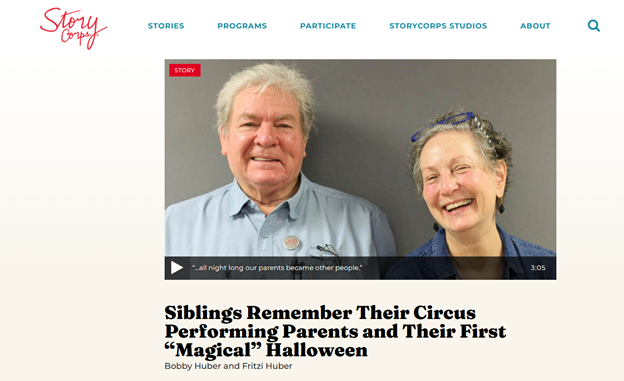
In the 1950s, Bobby Huber and Fritzi Huber were about six and seven years old when they learned about the existence of Halloween.
Their circus performer parents parked their trailer in the middle of empty farmland and pulled out all the stops to let their children experience trick-or-treating. The kids ran back and forth between the front and back doors of the trailer, begging for goodies, while the grownups quickly changed costumes and appeared as multiple characters.
“All night long our parents became other people,” Fritzi said in a recording for StoryCorps, a nonprofit oral history platform. “They would take parts of their costume that they wore in the act. [Mom] put on some crazy hat and came to the back door with her teeth blacked out.”
“And each one was [with] a different accent,” Bobby said.
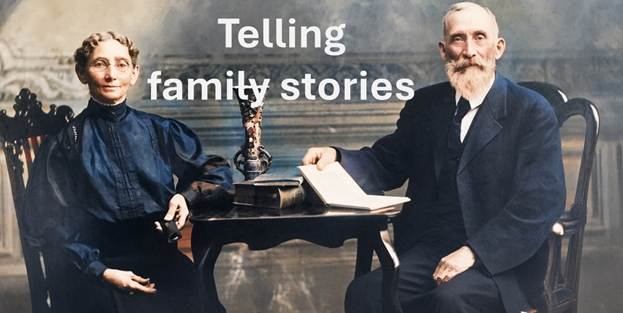
I mentioned the Hubers’ charming tale in my presentation “Telling Family Stories” at the Chenoa, Illinois, public library. My wife, Nonna, and I love the place. It’s a town of 1,720 people in the farmland along old Route 66 as it angles southwest from Chicago toward St. Louis. Yet the library is committed to bringing intellectual life to this farming community.
We all want to pass down a piece of ourselves for our children, grandchildren, and beyond. After the lecture, I found myself thinking this blog would be a good place to encourage readers to record pieces of their own lives and family histories. Storytelling happens in many ways: not just writing a memoir, but also mapping a family tree, creating a clipping book, posting in a Facebook group, or recording an oral history.
Today, let’s look at the last of these. Folks who would rather speak than write can follow the Hubers to StoryCorps, which records audio histories and partners with National Public Radio to broadcast some of them.
Other organizations are equally hungry for personal narratives. America 250, established by Congress, is hosting Our American Story, “a year-long, cross-country journey, collecting thousands of recorded interviews.” Similarly, the Library of Congress’ Veterans History Project “preserves and makes accessible the firsthand recollections of U.S. military veterans who served from World War I through more recent conflicts and peacekeeping missions.”
As for me, I have become interested in a wide range of my ancestors, from the Puritans who arrived in 1635, to my mother’s elder siblings who fought in World War II or watched their husbands head off to war.
Our yearning to tell stories speaks of our need to preserve some of who we are—our being, our consciousness—for those who come after us. I will be blogging about ways to carry forward family stories, both our own and the legends passed down from our ancestors.

