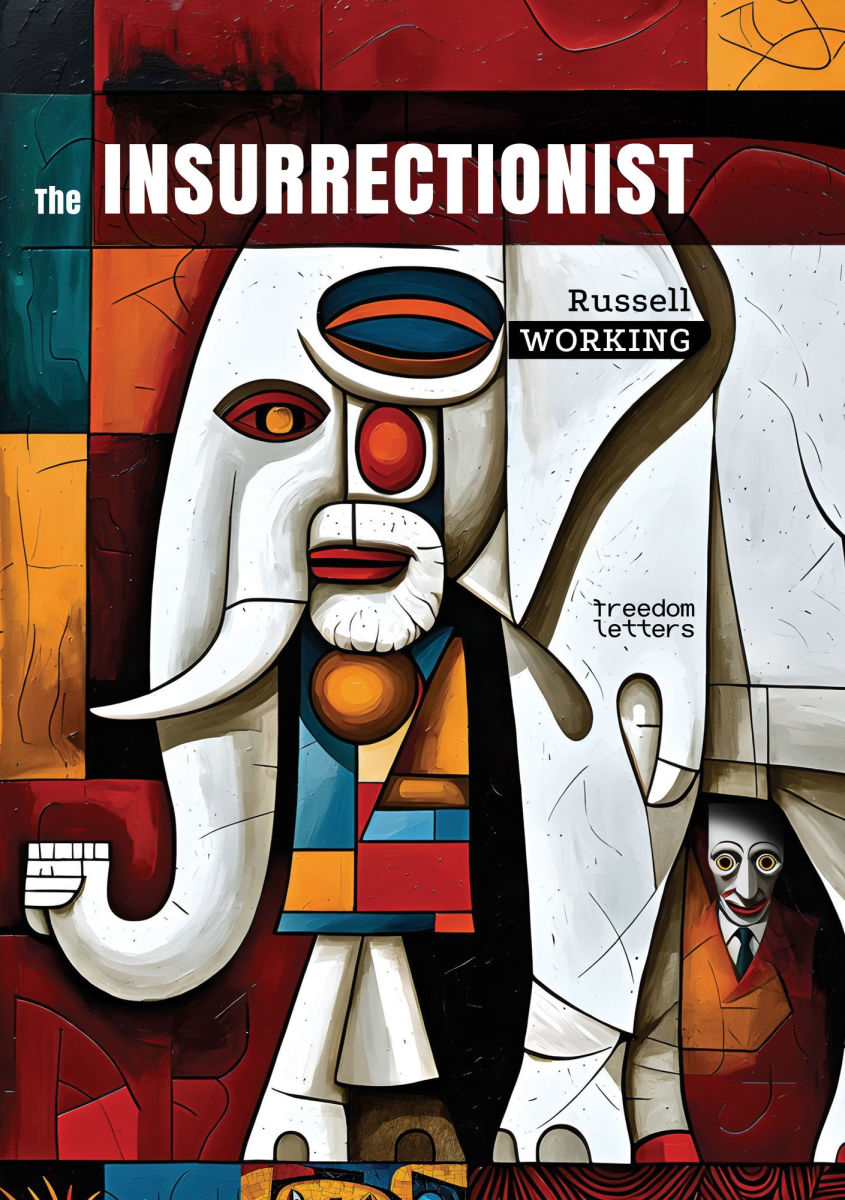
Max Nemtsov, who brought his immense talents to editing Nonna’s Russian translation of my novel The Insurrectionist, generously plugs the book here. A reminder: Max, like the publisher Freedom Letters itself, is a persona non grata in Putin’s Russia.
Before the book came out, one of our sons said, “You know that if you publish with them, you’ll never be able to visit Russia again.” I doubt that, but I do know that many brave Russian authors, designers, translators, and others involved with the press would be risking imprisonment if they returned.
A friend has asked where she can find a brief video I made last year plugging my novel. I am no longer on Instagram, so I am reposting it from Nonna’s account here.
I just learned of the passing this month of John Perkins, a Mississippi church leader and Civil Rights icon who was a friend of my parents.
Born in 1930, John fled Mississippi at 17 after a town marshal murdered his older brother. But he courageously returned in 1960 to start a reconciliation ministry there.
I recall hearing his sometimes harrowing and always inspiring stories over coffee after dinner at our home. In 1969 he tried to bail out protesters who had organized a boycott of White businesses in Simpson County, Mississippi, because of their refusal to hire Blacks.
John told us (and the linked story details) how the cops beat him up, kicking him all over the floor. They cut his hair with dull scissors and stuck a fork up his nose. The torture caused him to suffer a heart attack. Longer term, the experience left him with ulcers, and part of his stomach had to be removed.
The following grumpy dad harangue (from someone named Ethan Brooks on X) reminds me of when our kids were in school. It’s pretty funny—and is more entertaining than most flash fiction I run across. Read it all at the link.
Had a parent-teacher conference this morning
My wife told me not to come
I came anyway
She said “please just listen and nod”
I said “I always listen”
She said “you listen like you’re sitting in a boardroom looking for something to challenge”
That’s how listening works
Nice classroom
Small chairs
I am 6’4″ and was seated at a desk designed for someone who still believes in Santa Claus
I was walking up Michigan Avenue on my way to the Art Institute the other day when I noticed what looked like a Japanese teenager in front of the Chicago Symphony Orchestra building. She was holding a girly-pink violin case and posing for selfies in front of a framed poster advertising upcoming shows. Must be a student, I thought, or a music-loving kid on a school tour.
Nope. It was Himari, the 14-year-old Japanese violin prodigy, cutely posing beside a poster of herself. She’s playing here this week. We had to satisfy ourselves with a YouTube video of her, but she’s sensational. (She was 12 at the time of this performance.) And I love our city.
Financial adviser Chris Everett recently featured us on her new podcast. Check out what we had to say about freelancing from Russia, writing my J6 novel The Insurrectionist, and defending freedom of speech here in the United States. And Nonna has wisdom to offer about growing up in the Soviet Union, and why we celebrate America.
Max Nemtsov, editor of my wife Nonna’s Russian translation of my new novel, notes that a British publisher is redacting racial slurs and politically incorrect wording from a bestselling writer’s old books.
Did somebody predict this? I think so! In my satirical novel, The Insurrectionist, a Chicago newspaper forces a troublesome reporter to spend his workdays weeding such expressions from 172 years’ worth of digital archives. Which is why Max tagged me on Facebook. He writes, “As they say, life is more shameless than literature.”
The Guardian newspaper reports that Scottish writer Val McDermid was annoyed to be assigned a “sensitivity reader” to remove offensive language from her earlier works. She has sold more than 19 million copies worldwide and is known for her authentic dialogue, the paper notes.
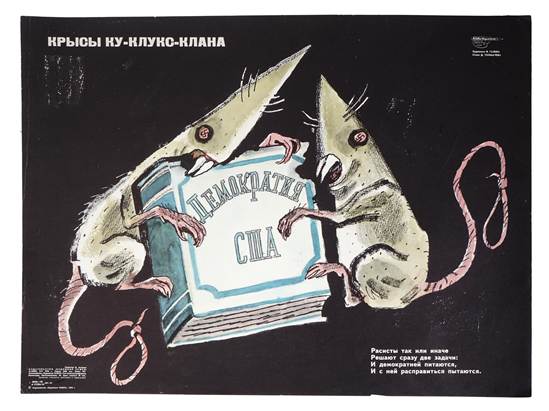
A Soviet poster reads, “Rats of the Ku Klux Klan: American Democracy.”
My wife’s Christmas present for me last month was inspired. For years I have talked about taking a drawing class, so she signed me up for one at an art studio in our Chicago suburb.
The class is ongoing, and the teacher began the session by laying out the previous week’s artwork (white pencil or gouache on black paper) and asking for critiques.
Disturbingly, one student artist had sketched a rat in a red MAGA cap crawling out of a tipped-over trash can. The message wasn’t as original as he perhaps imagined. Portraying one’s adversaries as vermin has a long and venomous history in Nazi, Soviet, North Korean, and other totalitarian propaganda.
Happy Thanksgiving, everyone. We are delighted to have younger son Lev home, but we dodged a culinary bullet. We nearly had to dine on Russell’s famous Thanksgiving fried liver.
The trouble was, I was late in getting started cooking. I’d worked on a short story, gone to the gym to work out, and strolled to the store to get the butter we’d forgotten. Plenty of time, methinks.
We’d decided to skip turkey this year, opting for a huge pork shoulder. But when we got it out of the fridge and unwrapped it, the carcass smelled like roadkill. I checked the sell-by date: Oh. This past Monday.
“We have liver,” said Nonna, my Russian wife. “I like your fried liver.”
“Not for Thanksgiving! We can’t eat liver. It’s un-American.”
She checked the freezer. “There’s pelmeni.”
“No! We’re treasonous enough not eating turkey. We can’t possibly eat pelmeni. Or liver. They’ll strip us of our citizenship.”
“I’ll never understand these Thanksgiving traditions of yours. What does it matter what we eat?”
“God is watching.”
I dumpstered the dead hog flesh, dashed to the store (by car this time), and got another ample pork shoulder. After speeding home, I hastily Grokked how long I should cook a six-pound pork shoulder, and…. What!? Seven hours!?
By now it was one o’clock. And I had to pick Lev up at the Greyhound station in 50 minutes.
Oh, well. Thanksgiving dinner at 8 PM. We doused the hog meat in olive oil and our very delicious mix of herbs and spices and stuck it in the oven.
When I picked up Lev, I broke the bad news. “Looks like we’re going to have to cook liver if you’re hungry. The pork shoulder won’t be ready until 8.”
“I’m down with that,” he said. “I like liver.”
How long, O Lord, must I dwell among the Philistines?
Luckily, as it turned out, the AI lied. Three hours was enough to cook us a crispy-crusted, tender, delicious heap of pork. And the liver can wait for another day.
I called my mother on Saturday, and as usual nowadays, she couldn’t really hear me. She misplaced her hearing aids while in rehab earlier this year, probably the third or fourth pair she has lost. Pity, because these were very advanced and expensive ones, probably costing $5,000.
But really, they provided only limited help. Her hearing, like my own, has declined to a point where hearing aids can’t do much to correct the problem.
Mom mentioned something annoying one of her caregivers had done. I said, “Was it Alejandra?”
“What?” Mom said.
“Was the caregiver Alejandra?”
She said, “I heard you say, ‘Was there a salamander?”