Tag Archives: soviet

When art preps the field for genocide

By Russell Working

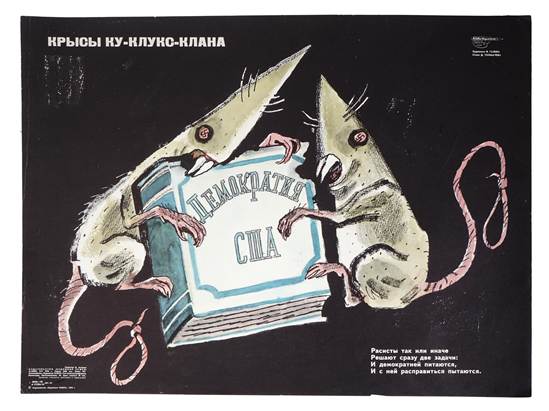
A Soviet poster reads, “Rats of the Ku Klux Klan: American Democracy.”

My wife’s Christmas present for me last month was inspired. For years I have talked about taking a drawing class, so she signed me up for one at an art studio in our Chicago suburb.

The class is ongoing, and the teacher began the session by laying out the previous week’s artwork (white pencil or gouache on black paper) and asking for critiques.

Disturbingly, one student artist had sketched a rat in a red MAGA cap crawling out of a tipped-over trash can. The message wasn’t as original as he perhaps imagined. Portraying one’s adversaries as vermin has a long and venomous history in Nazi, Soviet, North Korean, and other totalitarian propaganda.

Continue reading

Leave a comment

Filed under Uncategorized

Chemodan III: ‘Awfully happy’: George Walton finds love—and escapes the USSR with an aristocrat wife

This is the third post in a series about a mysterious suitcase that once belonged to a young Briton who followed his father into a career as a diplomat in the USSR in the 1930s. Check here for parts one and two.

Even before his posting abroad, George already had connections with the Soviet literary scene. With Reginald Merton he translated Aleksandr Neverov’s 1923 novel Tashkent: City of Bread (Victor Gollancz, London, 1930). The work prefigures the defining horror of George’s time in the Soviet Union: the famine induced by the Bolsheviks’ violent collectivization. From 1931 to 1934, millions would die in Ukraine, Russia, and Kazakhstan under the communists’ harebrained war on successful farmers, whom it dubbed “kulaks.”

In the novel, famine stalks the Volga River region around Samara. Twelve-year-old Mishka Dodonov has lost his father, grandparents, and other relatives to the hunger. To find grain for his mother and brothers, he rides the rails 1,300 miles to Soviet Uzbekistan.

From America to the starving of Russia: a 1922 poster hails food aid from the U.S.

In the Walton-Merton translation, the novel reads:

“The two younger ones were useless little people in these hard times; one spent his time begging for gruel, while the other was carving a toy windmill for the roof. The mother was weak with hunger. She used to go down to the stream for water but had barely strength enough to get back. But for all her cries and laments the famine showed her no mercy.

Continue reading

Leave a comment

Filed under Uncategorized