Tag Archives: russia

Chemodan III: ‘Awfully happy’: George Walton finds love—and escapes the USSR with an aristocrat wife

This is the third post in a series about a mysterious suitcase that once belonged to a young Briton who followed his father into a career as a diplomat in the USSR in the 1930s. Check here for parts one and two.

Even before his posting abroad, George already had connections with the Soviet literary scene. With Reginald Merton he translated Aleksandr Neverov’s 1923 novel Tashkent: City of Bread (Victor Gollancz, London, 1930). The work prefigures the defining horror of George’s time in the Soviet Union: the famine induced by the Bolsheviks’ violent collectivization. From 1931 to 1934, millions would die in Ukraine, Russia, and Kazakhstan under the communists’ harebrained war on successful farmers, whom it dubbed “kulaks.”

In the novel, famine stalks the Volga River region around Samara. Twelve-year-old Mishka Dodonov has lost his father, grandparents, and other relatives to the hunger. To find grain for his mother and brothers, he rides the rails 1,300 miles to Soviet Uzbekistan.

From America to the starving of Russia: a 1922 poster hails food aid from the U.S.

In the Walton-Merton translation, the novel reads:

“The two younger ones were useless little people in these hard times; one spent his time begging for gruel, while the other was carving a toy windmill for the roof. The mother was weak with hunger. She used to go down to the stream for water but had barely strength enough to get back. But for all her cries and laments the famine showed her no mercy.

Continue reading

Leave a comment

Filed under Uncategorized

Chemodan II: 2 + 2 = 5: Stalin coins a slogan, and 500,000 ‘dirty swine’ applaud death sentences

This is part two in a series about a mysterious suitcase that once belonged to a young Briton who followed his father into a career as a diplomat in the USSR in the 1930s. Check out parts one and three.

A school rugby team photo with the future Captain W.R. Frecheville of the Royal Engineers, whom the Bolsheviks would capture and execute in 1920.

Even as young George Walton was at Sedbergh, studying French, passing the ball on the rugby field, and bowling on the cricket pitch, he must have avidly followed his father’s career abroad. The Civil War was raging from 1918-1920. The U.K. deployed troops from the White Sea to the Sea of Japan.

In the south, where W.S. was stationed after he left Murmansk, the Royal Air Force flew combat missions against the Red Army. British ground troops and heavy Mark V and light Whippet tanks joined in the White attacks, Lauri Kopisto writes in a dissertation titled “The British Intervention in South Russia 1918-1920” (University of Helsinki, 2011). British tank crews led a successful assault on the Bolshevik stronghold of Tsaritsyn, later renamed Stalingrad. The Bolsheviks made clear their hatred for the foreigners, threatening to castrate and crucify any British prisoner of war who fell into their hands.

[Check out the new edition of The Insurrectionist.]

Continue reading

Leave a comment

Filed under Russia

Chemodan I: A mysterious suitcase’s tale of war, revolution, and love in the time of Stalin

This is the first in a three-part series. Check here for parts two and three.

I knelt packing my bag on the floor of the London townhouse of Andrew Fox, a British businessman and friend from when we both lived in the Russian Pacific seaport of Vladivostok. I had come here to interview him for a memoir piece on the 1990s and early 2000s in Russia’s “Wild East.” This was a turbulent era when mob-linked political bosses kidnapped journalists, a shipping industry whistleblower was blown to bits by TNT planted under her bed, and the governor threatened to jail Andrew, who also happens to be the honorary British consul general to the city.

I was double-checking my passport, wallet, and other essentials (My hearing aids! Oh, in my ears) when Andrew came thumping downstairs with a leather suitcase. As scuffed as old shoes, it was peeling open and dusted with dried mold that rubbed off like chalk on one’s clothes.

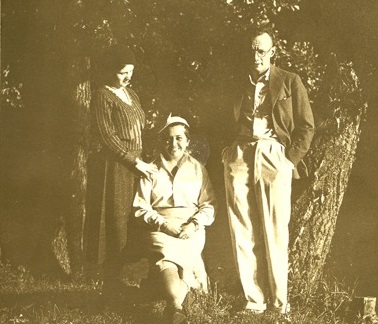
Unidentified photograph found in the suitcase, likely of George Walton, his wife Natalia (Tata), and his Russian mother.

“Before you go, did you want to take a look at this?” he said.

That’s right; he had mentioned something about a suitcase full of old British documents concerning Russia. I was heading to St Pancras to catch a train back to Belgium. Yet who could resist this strange object? “Suitcase” translates as chemodan in Russian, a word as ordinary as its English equivalent. But when applied to this curiosity, it seemed to describe a magical object that might pop up in an Isaac Bashevis Singer story.

“Sure,” I said. “We have time.”

Continue reading

Leave a comment

Filed under Uncategorized

The emperor and the interpreter

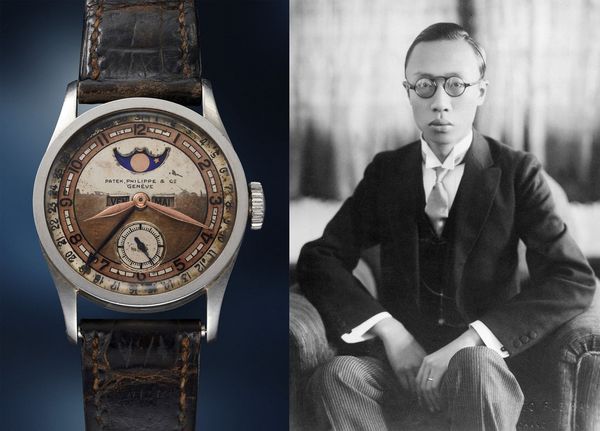
In May 2023, Nonna and I jetted to Hong Kong as guests of a storied auction house founded in 1796. Phillips had invited us for an event we never imagined participating in: the auction of a priceless watch that had belonged to Aisin-Gioro Puyi, the last emperor of China.

We had spent nearly a year working on contract for Phillips, helping verify the watch and writing a catalogue the size of a coffee table book. And suddenly we found ourselves schmoozing with the kind of people who could casually spend a fortune on a watch. The timepiece eventually sold for $6.2 million.

Continue reading

Leave a comment

Filed under Media, Puyi, Uncategorized, Watches