Tag Archives: books

Chemodan III: ‘Awfully happy’: George Walton finds love—and escapes the USSR with an aristocrat wife

This is the third post in a series about a mysterious suitcase that once belonged to a young Briton who followed his father into a career as a diplomat in the USSR in the 1930s. Check here for parts one and two.

Even before his posting abroad, George already had connections with the Soviet literary scene. With Reginald Merton he translated Aleksandr Neverov’s 1923 novel Tashkent: City of Bread (Victor Gollancz, London, 1930). The work prefigures the defining horror of George’s time in the Soviet Union: the famine induced by the Bolsheviks’ violent collectivization. From 1931 to 1934, millions would die in Ukraine, Russia, and Kazakhstan under the communists’ harebrained war on successful farmers, whom it dubbed “kulaks.”

In the novel, famine stalks the Volga River region around Samara. Twelve-year-old Mishka Dodonov has lost his father, grandparents, and other relatives to the hunger. To find grain for his mother and brothers, he rides the rails 1,300 miles to Soviet Uzbekistan.

From America to the starving of Russia: a 1922 poster hails food aid from the U.S.

In the Walton-Merton translation, the novel reads:

“The two younger ones were useless little people in these hard times; one spent his time begging for gruel, while the other was carving a toy windmill for the roof. The mother was weak with hunger. She used to go down to the stream for water but had barely strength enough to get back. But for all her cries and laments the famine showed her no mercy.

Continue reading

Leave a comment

Filed under Uncategorized

Chemodan I: A mysterious suitcase’s tale of war, revolution, and love in the time of Stalin

This is the first in a three-part series. Check here for parts two and three.

I knelt packing my bag on the floor of the London townhouse of Andrew Fox, a British businessman and friend from when we both lived in the Russian Pacific seaport of Vladivostok. I had come here to interview him for a memoir piece on the 1990s and early 2000s in Russia’s “Wild East.” This was a turbulent era when mob-linked political bosses kidnapped journalists, a shipping industry whistleblower was blown to bits by TNT planted under her bed, and the governor threatened to jail Andrew, who also happens to be the honorary British consul general to the city.

I was double-checking my passport, wallet, and other essentials (My hearing aids! Oh, in my ears) when Andrew came thumping downstairs with a leather suitcase. As scuffed as old shoes, it was peeling open and dusted with dried mold that rubbed off like chalk on one’s clothes.

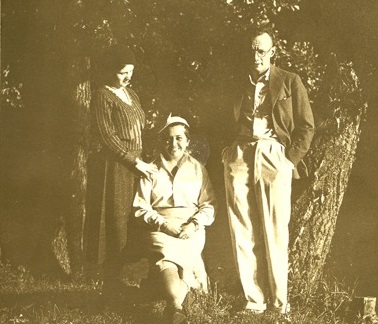
Unidentified photograph found in the suitcase, likely of George Walton, his wife Natalia (Tata), and his Russian mother.

“Before you go, did you want to take a look at this?” he said.

That’s right; he had mentioned something about a suitcase full of old British documents concerning Russia. I was heading to St Pancras to catch a train back to Belgium. Yet who could resist this strange object? “Suitcase” translates as chemodan in Russian, a word as ordinary as its English equivalent. But when applied to this curiosity, it seemed to describe a magical object that might pop up in an Isaac Bashevis Singer story.

“Sure,” I said. “We have time.”

Continue reading

Leave a comment

Filed under Uncategorized

Writing lessons from dishwashing, 40 years on

Here’s why Moses wandered the Sinai Desert for four decades: When you reach your sixties, four decades is the blink of an eye.

“Come on, old man, when are we getting to the Promised Land?” the Israelites surely told the grizzled prophet. “It’s been forty years already.”

“You’re kidding. Seems like only yesterday we left Egypt.”

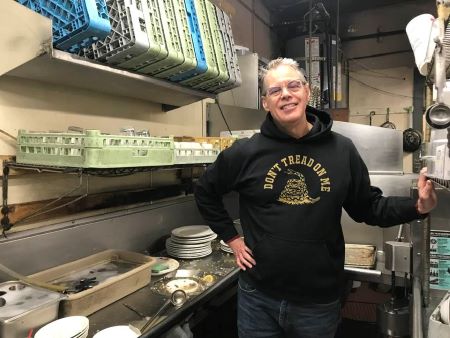
Such were my thoughts during a recent trip to Seattle when Nonna and I dropped by Julia’s in Wallingford. In the fall of 1984, I was an impoverished writer working as a dishwasher at the popular restaurant. Time flies, but that wasn’t the only conclusion I drew four decades on. Rather, the trip reminded me that in hard times you aren’t always aware of the greater plot of your life.

Continue reading

Leave a comment

Filed under Books, Fiction, Writing