
Reflections on a Roman sculpture.
The other day at the Art Institute of Chicago, we ran into a familiar figure: a bronze of the Roman general Nero Claudius Drusus Germanicus, generally known simply as Germanicus.
The statue stands in an exhibition of ancient Roman sculptures from Italy’s Torlonia Collection in Italy.
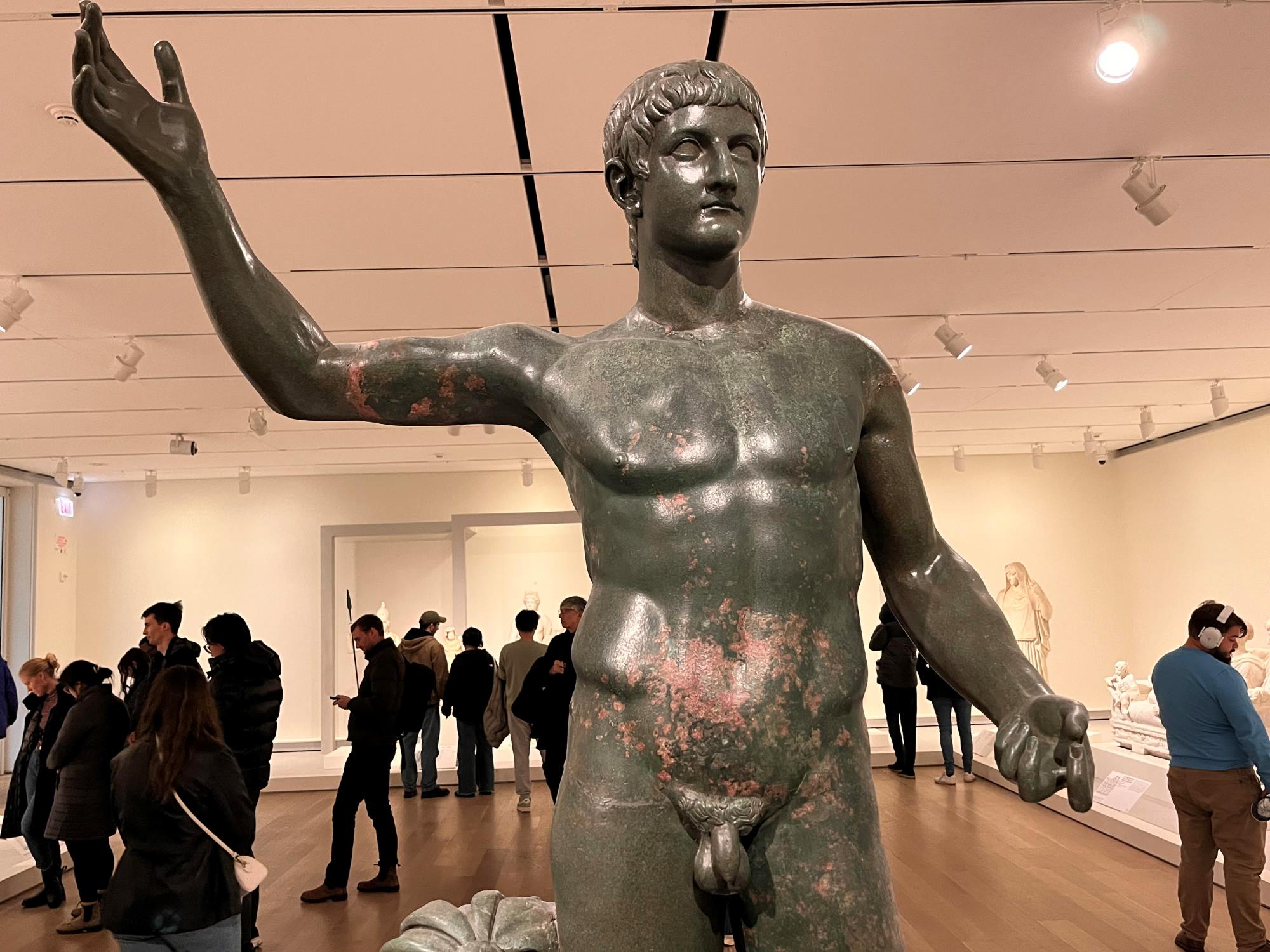
I felt as if I knew him. I first encountered Germanicus in 1976 as a teenager, while watching the BBC Masterpiece Theatre series “I, Claudius.” He was seen as was something of a first-century JFK, charismatic and full of promise before he was tragically assassinated.
I later read the source novel by Robert Graves, a tale of intrigue, murder, and palace coups among Caesar Agustus’ family. Germanicus won victories as a general on the German frontier but was later poisoned in Syria. Many blamed Emperor Tiberias, a brooding dissolute who was jealous of Germanicus’ popularity. Most dangerously to Tiberias, the soldiers adored their general.
‘Never equaled by anyone’
In the voice of Claudius (Germanicus’ brother, and a underestimated stammerer until he ascends the throne), Graves idealizes the general for his “courage, intellect, and nobility.” Born in 15 or 16 B.C., Germanicus would have ascended the imperial throne had it not been for his premature death, Encyclopedia Britannica says.
[Check out my novel, The Insurrectionist]
The Roman biographer Suetonius writes:
It is the general opinion that Germanicus possessed all the highest qualities of body and mind, to a degree never equaled by anyone; a handsome person, unequalled valor, surpassing ability in the oratory and learning of Greece and Rome, unexampled kindliness, and a remarkable desire and capacity for winning men’s regard and inspiring their affection. His legs were too slender for the rest of his figure, but he gradually brought them to proper proportions by constant horseback riding after meals. He often slew a foeman in hand-to‑hand combat.
Germanicus was poisoned in 19 A.D. while serving as governor of Syria. Many Romans suspected that Tiberias ordered the slaying, or at least made clear that he wouldn’t mind that outcome.
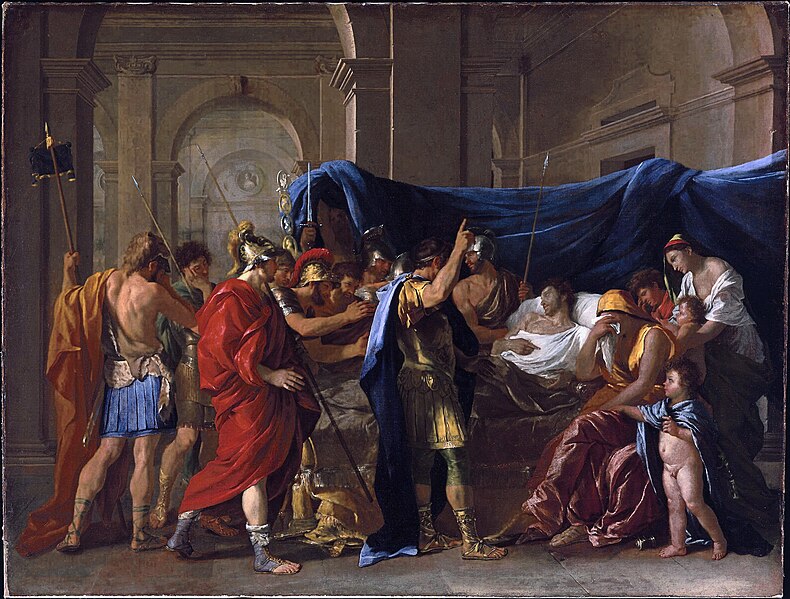
“La Mort de Germanicus” by Nicolas Poussin, 1658.
Last year I read swaths of Tacitus’ Annals, a history of ancient Rome. Fascinated by the mourning that followed Germanicus’ murder, I thought of writing a flash fiction piece about the return of his wife, Agrippina, and their children to Rome from Syria. But it hit me that I had little to add to Tacitus’ telling. So let’s leave it as he describes it when she arrives in the Greek island of Corcyra (modern-day Corfu):
Wild with grief
Without pausing in her winter voyage Agrippina arrived at the island of Corcyra, facing the shores of Calabria. There she spent a few days to compose her mind, for she was wild with grief and knew not how to endure. Meanwhile on hearing of her arrival, all her intimate friends and several officers, every one indeed who had served under Germanicus, many strangers too from the neighboring towns, some thinking it respectful to the emperor, and still more following their example, thronged eagerly to Brundisium, the nearest and safest landing place for a voyager.
As soon as the fleet was seen on the horizon, not only the harbor and the adjacent shores, but the city walls too and the roofs and every place which commanded the most distant prospect were filled with crowds of mourners, who incessantly asked one another, whether, when she landed, they were to receive her in silence or with some utterance of emotion. They were not agreed on what befitted the occasion when the fleet slowly approached, its crew, not joyous as is usual, but wearing all a studied expression of grief. When Agrippina descended from the vessel with her two children, clasping the funeral urn, with eyes rivetted to the earth, there was one universal groan. You could not distinguish kinsfolk from strangers, or the laments of men from those of women; only the attendants of Agrippina, worn out as they were by long sorrow, were surpassed by the mourners who now met them, fresh in their grief.
The mourning was even more intense in Rome—and, surprisingly, among the Barbarians, if Suetonius is to be believed.
On the day when he passed away the temples were stoned and the altars of the gods thrown down, while some flung their household gods into the street and cast out their newly born children. Even barbarian peoples, so they say, who were engaged in war with us or with one another, unanimously consented to a truce, as if all in common had suffered a domestic tragedy. It is said that some princes put off their beards and had their wives’ heads shaved, as a token of the deepest mourning; that even the king of kings suspended his exercise at hunting and the banquets with his grandees, which among the Parthians is a sign of public mourning.
Despite our current political divisions, perhaps we can agree that it’s a better world when, upon the assassination of JFK or William McKinley, nobody mourns by shaving his wife’s head or tossing his newborn children into the street.
 The Elephant Box