
This is the third post in a series about a mysterious suitcase that once belonged to a young Briton who followed his father into a career as a diplomat in the USSR in the 1930s. Check here for parts one and two.
Even before his posting abroad, George already had connections with the Soviet literary scene. With Reginald Merton he translated Aleksandr Neverov’s 1923 novel Tashkent: City of Bread (Victor Gollancz, London, 1930). The work prefigures the defining horror of George’s time in the Soviet Union: the famine induced by the Bolsheviks’ violent collectivization. From 1931 to 1934, millions would die in Ukraine, Russia, and Kazakhstan under the communists’ harebrained war on successful farmers, whom it dubbed “kulaks.”
In the novel, famine stalks the Volga River region around Samara. Twelve-year-old Mishka Dodonov has lost his father, grandparents, and other relatives to the hunger. To find grain for his mother and brothers, he rides the rails 1,300 miles to Soviet Uzbekistan.

From America to the starving of Russia: a 1922 poster hails food aid from the U.S.
In the Walton-Merton translation, the novel reads:
“The two younger ones were useless little people in these hard times; one spent his time begging for gruel, while the other was carving a toy windmill for the roof. The mother was weak with hunger. She used to go down to the stream for water but had barely strength enough to get back. But for all her cries and laments the famine showed her no mercy.
“You would often see people bearing a moujik to the cemetery, sometimes two together. The children’s uncle Michela and their aunt Marina had both died. In every house they were preparing for a funeral. Before, there had been horses and cows; but now they had eaten them all and were hunting cats and dogs.”
[Check out my novel, The Insurrectionist.]
George’s old college classmate, Muggeridge, would be among the few who broke the disgraceful silence of leftist Western correspondents about the state-induced Great Famine known as the Holodomor. In 1933 in the North Caucasus, he would notice “fields choked with weeds, cattle dead, people starving and dispirited, no horses for ploughing or for transportation, not even adequate supplies of seed for the spring sowing,” he wrote anonymously for the Guardian March 25, 1933. He saw police rounding up peasants for deportation to the camps, where untold numbers of them would die.
Encounters with authors
George’s surviving letters offer no indication whether he met Neverov in Moscow, but he did seek out other Russian writers. One day in my studio in Belgium, where I had a view of a garden where the birds did not cheep unless I put my hearing aids in, I was thrilled to read that George had tried to meet Mikhail Bulgakov, author of the surrealistic masterpiece The Master and Margarita. The writer, a doctor who had served in the Civil War, secretly drafted the novel from 1928–40 and hid it away until it was published in a censored form in 1966–67.
“In a few days’ time I am to meet Bougakov [sic] (the author of Dni Turbinykh [Days of the Turbins]) with a view of translating one of his unpublished works if suitable,” George writes on January 3, 1933. “There is a very nice Manchester Guardian correspondent (Muggeridge) with whom I was at Cambridge, and we are going to collaborate.”
I had never heard of Days of the Turbins. When I bumped into Eeva making espresso in the kitchen, I fetched George’s letter to show her. “Hey, look! George was trying to translate Bulgakov. But do you know what this was?”
“Dni Turbinykh? Sure, it’s a play based on The White Guard.”
As so often with the chemodan, a single page, a sentence, opened worlds. Bulgakov’s novel and play tell the story of a sympathetic family of White officers in the Civil War. This would hardly seem a likely candidate for stage production Stalin’s Russia. Government mouthpieces panned the play for being out of step with the new era, yet it ran from 1926 to 1941 and saw hundreds of performances, J.A.E. Curtis writes in his Bulgakov biography Manuscripts Don’t Burn. Stalin himself viewed the play at least fifteen times and protected the author from arrest, even as censors blocked publication of his further works. The dictator seemed to harbor superstitious fears of great writers, Nadezhda Mandelstam, wife of the poet Osip Mandelstam, recalls in her memoir Hope Against Hope.
“Why is Stalin so afraid of genius?” Osip once told her. “It’s like a superstition with him. He thinks we might put a spell on him, like shamans.”
I found no indication George ever succeeded in meeting Bulgakov; perhaps the Russian had second thoughts, knowing the dangers inherent in any contact with foreigners.
‘I’m awfully happy’
Unlabeled photo found in the collection—possibly of George, his mother, and Natalia in England.
The January 3, 1933, letter is also significant for personal reasons: it marks the first mention of the woman who would become George’s wife. Natalia Golitsyn (he transliterates it Golitzin) was, he claims, the daughter of a prince and a gypsy woman. Indeed the Golitsyns were an ancient family that had been central to court politics for centuries. George writes that Natalia’s grandfather owned the Kuzmenki estate near Moscow, a claim I was unable to confirm. She was just five feet tall, but then George himself was not much taller than she was, he writes. She wore her black hair shingled or baton-cropped, but when the light fell upon it, it became a very dark ginger. She was “not frightfully pretty,” George states rather ungallantly, “but she has such a wonderful smile, and when she does smile is very pretty indeed.” She went by Tata. George was twenty-nine, Tata twenty-seven.
It appears the couple met at the Metropol Hotel just off Red Square, an ornate Art Nouveau landmark that was a social center for expatriates in Moscow. Eugene Lyons, a United Press correspondent whom George knew well, describes the place in his memoir Assignment in Utopia as “a lonesome and rococo bourgeois island in the limitless ocean of Bolshevism.”
Its main restaurant was a Russian peasant’s dream of capitalist splendors—immense candelabra, oversized lights, heavy furniture, a jazz band of symphony orchestra proportions [Lyons writes]. The place always made me think of the Grand Central Station turned into a Rotarian banquet hall. The chief pride of the restaurant, its ultra-bourgeois touch, was a great circular pool where lights and rather proletarian-looking fishes played. On grand occasions, the chef in cap and apron emerged from his sanctum with a net over his shoulder and captured a fish for a special valuta [foreign currency] client. The dancing couples rotated around the pool, and sometimes an unsteady customer joined the fishes to the great delight of the assembled crowd.
The Metropol bar—open only to those paying in foreign cash—featured high stools, a footrail, rouged barmaids, an amiable bartender, and “all the trimmings even unto soggy potato chips,” Lyons writes. In his 1934 memoir I Photograph Russia, American photographer James E. Abbe describes the hotel in a section that would later become the target of a lawsuit by George and Tata (a matter I shall discuss below). The barmaids were handpicked for their good looks, Abbe says. They wore evening dress, and “they will dance with you on the ballroom floor which adjoins the bar.” Abbe continues:
“The barmaids in the big valuta hotels are of old Russian families, girls largely of aristocratic or bourgeois homes, who do not quite fit into office or more rigorous work. Theirs is a good job while it lasts because they are in close proximity to food from the restaurant kitchen. They meet nothing but foreigners, and Russians love to come into contact with foreigners. … However, when they do not measure up to Soviet expectations, they are liquidated—either sent to Siberia or disposed of in some other manner.”
Tata’s own family had become entangled with the feared GPU. With an insouciance that must have sent chills down his parents’ backs, George writes that her father “has been in jail but now coincidentally is friendly with the G.P.U. so can see me.” Despite George’s breezy tone, aristocrats were ruthlessly purged as “former persons.” A stint in prison was a permanent stain on a Soviet citizen’s character. And Tata had done time. Reader Bullard, a fellow British diplomat and memorable observer of Russia, mentions her in an entry from his published diaries dated April 2, 1934, when she and George called on him in Leningrad. (George also mentions this trip in a letter home.) Bullard, the Waltons, and an unnamed colleague toured Peter the Great’s palace at Peterhof, an estate rivaling Versailles in its grandeur.
“Mrs Walton isn’t a bad little creature,” Bullard writes. “She had nine months in an OPGU prison without allowing it to break her spirit. She told me that it sometimes happens in these crowded prisons that one of the prisoners will have a fit of hysteria and begin to scream, which spreads to others until perhaps hundreds are screaming uncontrollably. Walton says people who live near the OPGU place in Moscow have heard the screaming more than once, and describe it as terrifying.”
If George’s parents were dying to hear more about this mysterious girlfriend, they would have to wait. After the tantalizing mention, George is silent about Tata until a year later, when he drops a bombshell in a January 1934 letter.
“Now my news,” he writes. “Over a month ago I got married to Tata (Natalia) Golitzin.”
He goes on:
“She is awfully nice & we are very happy together. I have wanted to marry her for over a year but she was afraid it might affect my career & would not do it. I am enclosing a photograph which is really very little like her, & was taken nearly a year ago. … I am sure you will like her. I did not do this on the spur of the moment but thought it all out beforehand.
“The time would come and would have to get married. If I married an English girl it would mean that she would know nothing about Russia or Russians where my life would be. … The only thing against Tata is that she has no money. But even then she has, if we can only find her guardian, a fairly large sum under her grandfather’s will which was deposited in England before the war. As for her family there are very few better in Russia. She is an orphan, her father died in 1919, and her mother was married again, so from the point of view of ‘Rodina’ [motherland] is quite all right. She is clever, well educated, and used to write poetry for publication. Please do nice to her because she is worth it. Everybody here is very fond of her, not because she is my wife but just because she is what she is. However you will be seeing her shortly.
“Please do not think that I have made a bad marriage. I am most awfully happy.”
Perhaps the marriage was what ended George’s diplomatic career that year, though he might felt compelled to return to London in order to take over the family shipping business after W.S. died that spring. A Russian wife would have made George a security risk. The GPU could arrest Tata on any pretext, or blackmail George by threatening to do so, putting His Majesty’s Government in an untenable situation. His letters in the spring of 1934 tell of his struggle to obtain a passport and exit documents for her. The Soviets did not easily let their citizens escape, often demanding large sums of cash for an exit visa and external passport. Frustrated, George writes home in Russian, addressing his mother by the endearment Mamechka yet using vy, the formal “you” equivalent to vous in French. (Vladimir Nabokov, born just four years before George, notes that children of his generation often did this.)
“As I told you on the phone,” George writes, “I was promised that Tata would get her exit from the Soviet citizenship. 63 days. But, as always, it was not done by the Narcomindel [People’s Committee for Foreign Affairs]. Bastards!”

An unlabeled photo from the suitcase. Could it be Natalia?
Spring brought sad news from London with the death of W.S. April 22, 1934. Upon returning to England from Russia, he had entered the shipping industry. As late as 1932, he was active in business, purchasing an Italian ship from one Captain Roujansky, the Fairplay Weekly Shipping Journal reports. His passing was noted in the April 26 edition of Shipbuilding and Shipping Record: “The death occurred on Sunday of Mr. W.S. Walton, a director of the Regier Shipping Co. Ltd., London, since its formation in 1921. He had been a member of the Baltic Exchange since 1925.”
Tata offered her condolences to her mother-in-law in an undated letter, addressing her in Russian by her first name and patronymic:
“Dear, dear Maria Nikitishna:
“There are no words, especially on paper, to express my compassion to you. But I share your grief with all my soul and heart. It is very difficult to write about it and all the words turn to be wrong you will understand my feeling without them.”
Escape from the USSR
The Waltons finally escaped from the Soviet Union in August. Among the suitcase’s papers is a telegram from George in Moscow: “ARRIVING FRIDAY 8/30 A M DO NOT MEET ME = GEORGE.”
Several years after their return to London, the couple sued Abbe, the photographer, over a defamatory description from his memoir I Photograph Russia. In the section on the barmaids in valuta hotels, Abbe sniggers at the Waltons in terms that clearly identified them to those who knew them.
I know of one instance where a barmaid at the Metropole [sic] Hotel became so friendly with a member of a foreign embassy that it became a matter of suspicion as to which one was getting the most information out of the other. The situation became so dangerous that the Embassy man married the girl. Unfortunately, the British Ambassador could not reconcile what might have been considered a gentlemanly action with the possible loss of prestige to His Majesty’s Embassy, so the young diplomat left the service.
Indignant at the suggestion that they were simultaneously traitors and dupes, Waltons sued Abbe and his U.S. publisher in the Supreme Court of New York County. The clueless photographer had subjected them to “hatred, ridicule, infamy, contempt and disgrace,” they alleged in a libel suit against Robert M. McBride and Co. Worse yet, Abbe’s book indicated that George “was guilty of treachery and betrayed his country by giving and divulging information of state to a spy and decoy of a foreign service, to wit, the G.P.U.,” the suit asserted. Abbe’s characterizations must have especially stung, given Tata’s harrowing incarceration by the GPU.
Abbe and McBride’s defense was feckless—heck, distribution was a trifling 3,333 copies, and few in America knew the Waltons, who were not named. Besides, he had indemnified the publisher. But the chemodan reveals that the British publishers offered a settlement of an unknown sum and a retraction offering “our sincere apologies for any loss, unpleasantness or inconvenience you may have been caused by the statements made on pages 180 and 181 of the book ‘I Photograph Russia.’”
Though Waltons’ anger is palpable, one point must be made: It is inconceivable that the GPU wasn’t watching and interrogating the staff of the hotels where expatriates congregated. Even in the post-Soviet 1990s, an officer with the FSB—chief internal successor to the GPU and later the KGB—once phoned my Russian wife at the English-language newspaper where we worked in Vladivostok and told her to come down to his car. He wanted to know what all those foreigners in the newsroom were up to. At the risk of drawing the wrath of the Waltons’ ghosts, it is not impossible that Tata was actively planted in order to gain information from the English diplomat, though Abbe could not possibly know this.
That said, it’s unlikely she could have deceived an observer of George’s sophistication, class, and linguistic fluency about her aristocratic status. And why would a GPU stooge tell such harrowing tales about her imprisonment, knowing that Bullard would report her words back to London? In the end, the Waltons’ marriage was by all appearances happy. The notion that they were betraying their respective countries was reckless and incendiary, and would have harmed George’s employment prospects.
Having left the Foreign Service, George returned to run his late father’s shipping business. A letter from June 1941 indicates that George had been employed as a salaried director of two steamship companies since 1934. George’s company owned the Danubian (the ship in the photo I discovered). The chemodan contains a 1944 pamphlet from the admiralty titled Defensively Equipped Merchant Ships.
Clearly the Waltons never unearthed the treasures of the Golitsyns in England. The World War II years took their toll on his shipping interests. George struggled to pay his taxes, receiving final demand letters from the Collector of Taxes over several years. At least twice the Kensington Divisional Petty Sessions summoned George to show cause why he had not paid his rates and assessments. His efforts to return to government work faltered when Whitehall brushed aside his application for a staff position on the Allied Commission for Austria. The parsimonious reference letters he secured from his former supervisors in Moscow would not have added much luster to his job applications.
George continued to be interested in contemporary Russian literature. He sought unsuccessfully to translate the works of the writer Yury Tynyanov. In 1936 he did co-translate, with Philip Gibbons, Jen Sheng by Mikhail Prishvin (London, Andrew Melrose). It is the true story of a Russian scientist who joined forces with a Chinese hermit in a remote corner of the Pacific region known as Primorye, where Vladivostok is located. In a Sept. 1, 1936, brief review, Kirkus called it “an exquisite fragile sort of book. … It combines a rare appreciation of nature at close hand, with a philosophical content, in the symbolic study of the meaning of life and the search for Jen Sheng.”
When I returned to the States, my wife Nonna found a letter from Prishvin to Walton in the chemodan. The author told George he had started learning English so he could read the translation, and he was impressed George’s work. By contrast, Prishvin said, he was unhappy with a German edition.
“I’m very, very grateful to you for the invitation to come,” he wrote. “This will be my daydream, but it won’t be very soon that I will implement it. I need to issue another book and get money for the trip, and I need to learn English better.”
Down rabbit holes
I worked on the chemodan for a year—diving down rabbit holes, exploring storylines, requesting books from distant libraries—before abandoning it in 2015 to write an unrelated novel. I confess I found George and W.S.’s archive overwhelming, with its troves of documents about parties at Armand Hammer’s mansion in Moscow, Bolshevik atrocities in the Far Eastern town of Nikolaevsk, an impoverished noblewoman’s attempt to sell her fur coat in Constantinople, and the Czechoslovakian army’s escape from Russia during the Civil War. Recently, though, the chemodan lured me back. I felt I owed it to George and W.S. to write this essay, and I wanted to explore further story ideas within the documents.
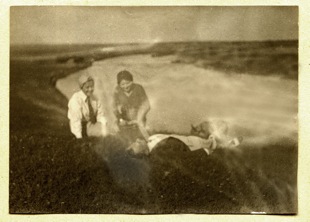
George and Tata apparently never had children. A lost dog notice he wrote in June 1938—possibly to have printed or to tack up in a pub—poignantly explains the matter. Their Scottie bitch, which they called both Lialia and Tiavka, might be the dog sniffing about in the photograph of the man and two women in the countryside.
“Tata, my wife, and myself are a childless couple, George writes. “We have been married for six years [sic]. Three years ago the doctor told us things, and we had a dog. Tata had had dogs all her life, and so had I. Our home, a flat, was empty without the welcoming smile of our ‘daughter.’”
She chose us in a pet shop in the Harrow Road. We looked at her through the netting of the window, came home, counted out the pennies and decided that she could buy us. We even paid a ten-bob deposit on her; we husbanded our pennies and on[e] Saturday she was ours.
George visited every shelter in the area, to no avail. The Metropolitan Police, he says, gave him a form that explained, “Under the Dogs Act, 1906, dogs may be disposed of after 7 days.”
“Disposed of?” he cries. “If you hear of Lialia, alias Tiavka—PLEASE!”
Lialia (Ляля) is a variation of Lialka, the name five-year-old George gave his baby sister. (He also adopted a stray in Moscow and named it Lialia.) Unfortunately, English speakers tend to find it difficult to pronounce correctly. It is unlikely the Scottie would respond to a beery pubgoer stamping after her and hollering incomprehensible syllables. I don’t know whether the Waltons ever found their “Baby,” or whether they were ever surprised by a pregnancy. Such things do happen.
Final years in England
Death records indicate that a William George Walton, born February 13, 1903, died in the Kentish town of Tunbridge Wells, thirty miles southeast of London, early in 1979. If this is our man, the birthdate is correct but for a typo in year; both his résumé and Sedbergh School record it as February 13, 1902.
Were George and Tata disappointed by their return to England to face years of debt, taxes, childlessness, and job disappointments, rather than Golitsyn riches? Or did such hurdles seem trivial when weighed against her escape from a prison camp the size of a continent? Princess or no, Tata was a prime candidate to be purged, whether to perish in an Arctic gulag or be dispatched with a bullet in the back of the head. Instead, she evidently carried on almost to the age of ninety-three.
A Natalia Walton of Tunbridge Wells, whose year of birth, 1905, corresponds with Tata’s, survived George by nearly two decades. She died in May 1998, just a year before Warner Dailey unearthed the suitcase. Perhaps her heirs dumped it out on the attic floor, hoping find a tiara or gilded icon or treasure map guiding them to buried Golitsyn riches in the garden. Then I imagine they stuffed it all back in the chemodan, disappointed, and let a buyer cart it off, along with the mismatched cutlery and a couch still smelling of the good English cigarettes George smoked. But in tossing out the chemodan, they discarded a treasure greater than the wealth of the Golitsyns.
Surely George and Tata had their regrets; most people do. Yet as millions were liquidated, she survived. She lost her homeland but found the consolation of love. She and George lived the sort of ordinary life denied to her countrymen, who spent decades starting awake in terror at night at the sound of footsteps on the apartment stairway, heralding a predawn raid by the GPU. And if the Waltons’ life wasn’t a succession of ballroom dances and croquet parties and vacations on the Riviera, surely they considered themselves blessed, compared to those they had left behind in the blood-soaked motherland.
Not a bad life, Tata perhaps reflected in old age; not a bad life at all.
 The Elephant Box