
Here’s why Moses wandered the Sinai Desert for four decades: When you reach your sixties, four decades is the blink of an eye.
“Come on, old man, when are we getting to the Promised Land?” the Israelites surely told the grizzled prophet. “It’s been forty years already.”
“You’re kidding. Seems like only yesterday we left Egypt.”
Such were my thoughts during a recent trip to Seattle when Nonna and I dropped by Julia’s in Wallingford. In the fall of 1984, I was an impoverished writer working as a dishwasher at the popular restaurant. Time flies, but that wasn’t the only conclusion I drew four decades on. Rather, the trip reminded me that in hard times you aren’t always aware of the greater plot of your life.
In 1984, two years out of college, I moved to Seattle to write. I rented a room in a house with a bunch of recent graduates of a university I hadn’t attended. They were all pals, sharing in-jokes, cooking together. I hardly knew them. I had just come off working at a paper mill at Longview Fibre Co. down on the Columbia River, my all-time worst job. The crew was overjoyed when I, Central Mill’s most hapless employee, quit before I fell into the giant blender of the pulper or got myself squashed walking under a crane hoisting a piece of machinery the size of a suburban tract house.
[Check out Russell’s new novel, The Insurrectionist.]
Hard times
What’s more, when I moved to Seattle, I had just recovered from a double ear infection that left me with a profound hearing loss. Every morning I awoke and lay in bed and waited for the room to stop spinning. A tinnitus din incessantly squealed and buzzed in my ears. Overnight I became an introvert, avoiding conversations, which tended to embarrass both me and my interlocutors. Mornings and evenings I pounded away on an electric typewriter, annoying my housemates with the rattling.
I landed a job at the first place I applied for work: Julia’s. Employees got one free meal and one beverage a day. I stretched that by eating a sweet roll for breakfast and my salad for lunch. I took home day-old bread and gallons of burnt soup and other throw-aways. They distributed our tips on Thursdays. That evening, as the sunset incinerated the Olympics and tinted the Cascades pink, I would walk to a waterfront bar on Lake Union where the happy hour sideboard featured chips and cocktail hotdogs. For the price of a beer I got another free dinner. But it was a bleak life. At my steamy work station, food dribbled off my plastic apron onto my sneakers. When I visited friends with dogs, the brutes kept slobbering all over my shoes.

Rejection after rejection came in the mail. Still, I believed against all odds that I had the talent to make it as a fiction writer. It helped that one manuscript came back from Harper’s magazine accompanied by a two-page, single-spaced reply from an editor named Charis Conn who raved about my work and encouraged me to keep at it. (Unfortunately, the magazine was no longer publishing fiction at that time.) The story was “Resurrectionists,” which would become part of my eponymous first collection.
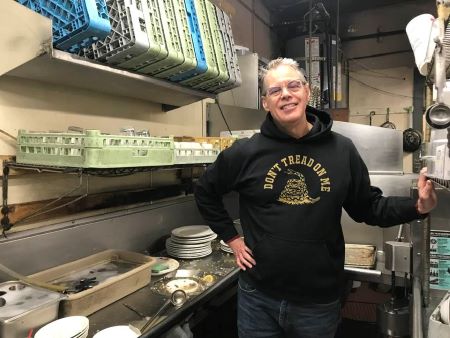
These days the brunch at Julia’s is still delicious, but the joint is no longer open for dinner. The once-bustling restaurant—with cooks, prep chefs, multiple wait staff—seemed to have a late-morning crew of one cook and just two waitresses. Surely there was a dishwasher somewhere, but the plates were piling up when I posed for a photo in my old work station.
New Year’s seizures
Fittingly, among the people I caught up with in Seattle were two college friends. On New Year’s Eve 1984, my housemates were planning a raucous party, and my friends Kael and Anne invited me to a quiet celebration at their house. After we toasted the New Year, I slept on their couch.
Deep in the night the lights came on, and Kael was standing over me. “Are you all right?” he said.
Why was he waking me to ask this? “Yeah, I was sleeping just fine.”
“You just had a seizure,” he said.
“Oh,” I said, bewildered. I looked around. I was lying on the floor.
I had never had convulsions before. Kael helped me back onto the couch.
Next time I woke I was in an ambulance, lights flitting by as I headed to the University of Washington hospital. They had called 911 after I’d had a second seizure. I had a third in the ambulance.
In the hospital a nurse asked me what kind of work I did. I couldn’t remember dishwashing. All I knew to say was, “I’m a writer.”
“Have you published anything?” she said.
“I don’t remember.”
When I recovered, I ended my career as a dishwasher and returned to Longview to regroup at my parents’. Nobody ever figured out why I had the seizures. Maybe they were a side effect of a medication I was taking. But the experience became part of another short story I would include in my first collection. I named it “Charis.”
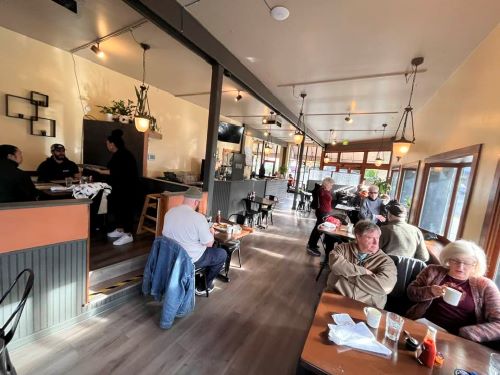
All this I remembered as Nonna and I visited Julia’s again. Forty years have passed since 1984, my annus horribilis. And yet, dismal as it was at the time, I was writing, story by story, the book I would submit for the Iowa Short Fiction Award the following summer. I won first prize, held my first book in my hands, and garnered a New York Times Book Review brief so thrilling, I couldn’t breathe as I read it.
The Israelites got the Ten Commandments and a sizeable chunk of the Bible out of their sojourn in the wilderness. I got the better part of my first book while working at Julia’s. Even when trekking the Sinai or hosing eggs benedict from breakfast platters, you never know what you might be accomplishing long-term.
 The Elephant Box