
Hordes of Mongols, multitudes of Visigoths, entire Tribes of Israel, and jalopy-loads of Oakies are already thronging Route 66 on their way to Chenoa, Illinois, for a lecture and reading I will deliver on Sept. 24. If you and your chain-migrating clan happen to be in the neighborhood and wish to claw and pummel your way into the crowded venue, possibly losing an eye or an ear in the melee, please join us.
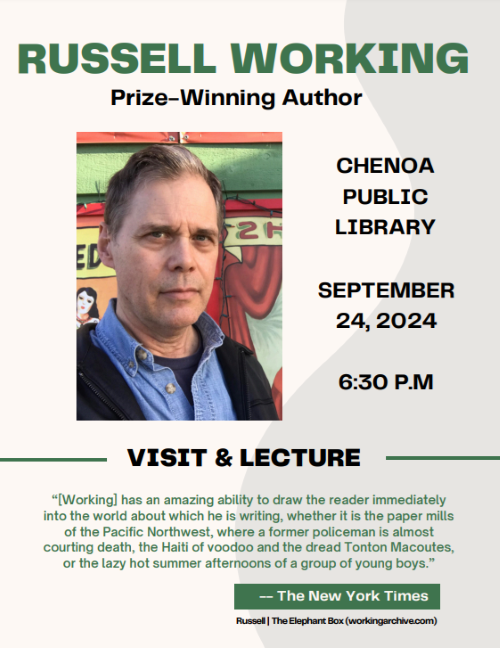
Fittingly, for a handbill promoting the much-anticipated event, the Chenoa library grabbed a photograph of me in front of a circus sideshow museum in the tourist trap of Uranus, further down the celebrated highway in Missouri. Why Route 66 is so famous, beyond a forgotten TV series by that name from the early sixties, is a question for pop historians. (Fascinatingly, Jack Kerouac once contemplated suing the series for misappropriating characters and themes from his On the Road.) However, you will find many fine oddities along the way, among them a store entirely devoted to Donald Trump paraphernalia, a 19-foot fiberglass statue of a smirking lout holding a hot dog, and an octagonally shaped library in a town Abraham Lincoln used to visit as a prairie lawyer riding the judicial circuit.
On a recent drive to Oklahoma for a family funeral, we dropped in on a dozen rural libraries to litter their bulletin boards with flyers advertising my new novel, The Insurrectionist. The size of those repositories of reading seemed out of proportion to the population of their towns. (Chenoa is home to 1,695 people.) Smalltown farmers and Chamber of Commerce members face the same distractions the rest of us do, with addictive smartphones and the allure of woke Netflix movies where svelte, diverse girlbosses beat up linebacker-sized hulks reeking of toxic masculinity. But you get a sense that books still matter in these places, or at least the memory of the library as a cultural institution does. Chenoa and other places still cherish their libraries.
The string of libraries, with their learned staffers and cool rows of stacks to retreat to on sweltering days, offer a glimpse of how literary culture persists. In several small towns they are expanding old libraries or building new ones. I found this reassuring in what the Canadian author Douglas Glover calls “a post-literate age.” In his essay collection, Attack of the Copula Spiders, Doug (a friend of mine), laments our civilizational nadir:
“Books used to be seen as a threat, as dangerous articles capable of corrupting morals or inspiring passionate love, igniting revolutions or sowing, variously, liberty, disorder and oppression. Books had to be watched, banned, proscribed, listed, condemned, and bowdlerized. Ulysses and Lady Chatterley’s Lover were put on trial. Henry Miller’s work was banned in the United States. But not anymore. Not now. No need to burn or memorize or smuggle books because, in fact, nobody reads them anyway.”
Perhaps libraries like Chenoa’s can serve a monastic function, preserving treasured texts for a future, more literate age. That is, if the building survives the blackjack- and saber-wielding rioters fighting for admission to my event.
 The Elephant Box