
In May 2023, Nonna and I jetted to Hong Kong as guests of a storied auction house founded in 1796. Phillips had invited us for an event we never imagined participating in: the auction of a priceless watch that had belonged to Aisin-Gioro Puyi, the last emperor of China.
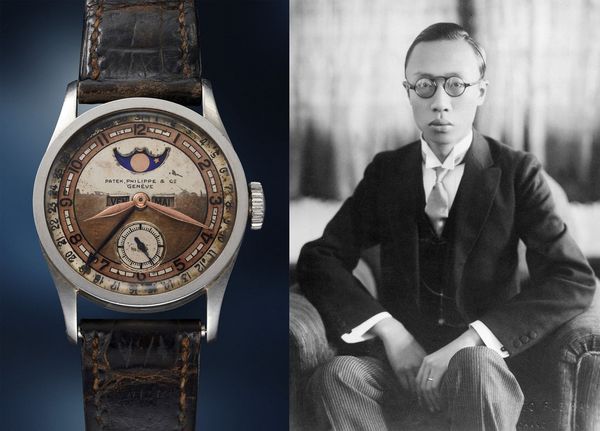
We had spent nearly a year working on contract for Phillips, helping verify the watch and writing a catalogue the size of a coffee table book. And suddenly we found ourselves schmoozing with the kind of people who could casually spend a fortune on a watch. The timepiece eventually sold for $6.2 million.
The auction drew worldwide media coverage. Among many newspapers and magazines writing in multiple languages, the Chicago Sun-Times, our old rival when I worked at the Tribune, covered the sale with a front-page story on me. (The article should have been about Nonna as well, as you’ll see when you read this post, but she was a good sport about it.) Recently, it occurred to me that I had never posted about this during the years I was neglecting this blog.
So by way of introduction to the topic, here is my foreword for the auction catalogue.
—Russell Working
The old man said he had proof. He’d known the last emperor of China. Look, he said, right here. Georgy Permyakov cleared the clutter on his desk and opened drawers to produce a beautifully painted fan, a notebook filled with essays in Chinese writing, and a priceless platinum Patek Philippe calendar watch.
The essays were interspersed with whimsical figures formed out of Chinese characters. ‘You know who drew these? Henry Puyi, the last emperor of China,’ Permyakov said, referring to Aisin-Gioro Puyi by his English name. ‘That fan, he inscribed himself.’
These items, along with a lovely series of watercolors by Puyi’s brother-in-law, formed a unique collection that Permyakov had held after the former emperor’s imprisonment in the Soviet Union from 1945-1950.
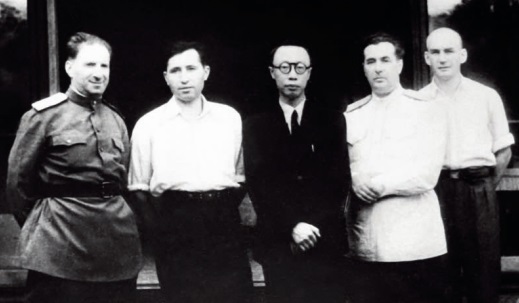
The year was 2001, and my wife, Nonna, had tracked down Permyakov—then 83 years old—in the Russian Far Eastern city of Khabarovsk. We were there to interview him for an unrelated story. What we hadn’t anticipated was Permyakov’s connection to Aisin-Gioro Puyi—also known as Emperor Xuantong—who ascended the Dragon Throne as a toddler in 1908. The elderly translator had interpreted for Puyi and taught him the Russian language and communist doctrine. Permyakov’s artifacts revealed a unique relationship.
He and Puyi knew each other as captor and captive, yet there was evidence of a friendship between the two men. Puyi inscribed the fan as a gift for Permyakov when the two were in Tokyo in 1946, composing a poem in Chinese. Puyi ascended the throne in 1908 at the age of 2. After he was ousted in Beijing, the Japanese installed him as ruler of the puppet state of Manchukuo. When the Soviet army entered
China and captured him in 1945, he spent five years in Soviet Union. A home without a phone It was a roundabout path that led us to Permyakov. As freelance writers based in Vladivostok, we travelled widely in Russia, as well as other Asian countries. In 2001, after a visit to Permyakov’s former hometown in Harbin, China, we caught the train to Khabarovsk, an Amur River city of about 600,000 people. Nonna ran across Permyakov’s name while paging through bound volumes of old, yellowed newspapers, looking for information on a post-war trial of Japanese prisoners in the Soviet Union. She asked reporters at a local paper if the interpreter was still around.
They said sure. He doesn’t have a phone, they told her, but write him a letter and leave it at the post office. He comes and picks up his messages there. If he’s willing to talk, he’ll reply. The next day Permyakov had left a note for us. The answer was yes.
We found him in a dreary apartment block, but his bookshelves were crammed with a lifelong author and linguist’s books and papers.
Why no phone? Well, they were hard to get in Soviet times, and he never requested a line anyway. This was one of the ways he kept a low profile. Although he had worked for the NKVD—the dreaded secret police later known as the KGB—government agents followed him throughout the Soviet era. He feared for his life. Bald-headed and full of infectious enthusiasm, Permyakov was a former athlete, teacher, and writer who remained robust into his eighties. As I wrote for the South China Morning Post at the time:
“Georgy Permyakov is 83 years old and so fit he will spring to his feet and pound his stomach to prove he retains some of the strength of his youth as a boxer. He never drinks or smokes, speaks six languages, and sleeps on his balcony in Khabarovsk most nights, even in Russia’s winter. He chatters in Japanese and Putonghua and is a little gleeful when visitors stare blankly back.”
The former interpreter cheerfully watched my jaw drop when he told me of his connection to China’s last emperor. I had learned about Puyi from “The Last Emperor”, a 1987 movie directed by Bernardo Bertolucci. The film portrayed Puyi’s capture by the Soviet Red Army in 1945 as he tried to flee for Japan. What the film left out was the years Puyi subsequently spent in Soviet Union, relying on Permyakov for all his interactions with his captors.
Some subjects you report on have a way of staying with you. Permyakov was one of them. In late 2001 Nonna and I left Russia. After freelancing from Cyprus, we ended up in Chicago, where I worked for the Tribune. But we sometimes reminded each other of the charismatic old interpreter. On bitter winter nights, we marveled at Permyakov’s habit of sleeping out on his balcony in Khabarovsk, where temperatures can dip as low as minus 40 degrees (the temperature is the same in Fahrenheit and Celsius). I used to say, “When I get old, I want to be as fit and alert as Permyakov.”

But more than two decades after we had interviewed Permyakov, I was surprised when the old story resurfaced in 2022. A researcher for Phillips messaged me. They were interested in talking to us. Oh, and did we have any photos of Permyakov, Puyi’s watch, the fan, and the other objects?
After so many years I said we almost certainly did not. But I had underestimated my wife’s organizational skills. It turned out she had stashed away a bound volume of the negatives I had shot of Permyakov and his treasures. And so we find ourselves involved once again telling the story of one of 20th-century China’s most fascinating figures. The artefacts themselves whisper tales of a fallen dynasty and of the transformation of its ruler from ordinary to citizen.
And while the collection hints at the tumultuous forces that created modern China, it also tells a more human tale—of the comradeship of an emperor and the interpreter who gave him his voice and helped him find his way in a foreign land.
“This book will be destined for cult status.” My new novel, The Insurrectionist, is winning five star reviews on Amazon. A reporter pursuing a Jan. 6-related story ends up entangling two families—including his own—in an FBI investigation in this dark satire that lampoons the news media and woke America.
 The Elephant Box